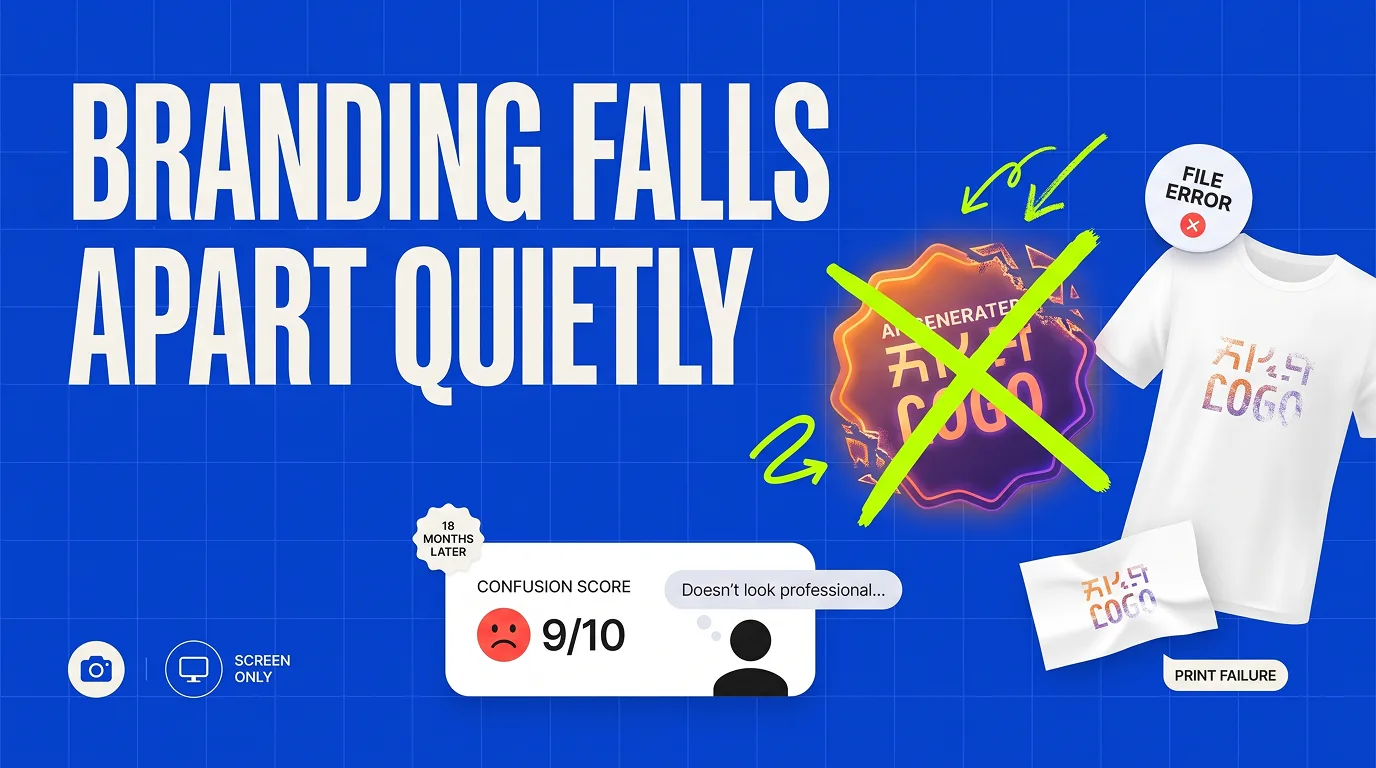
In our experience working with small business owners on their websites and their brand, one story keeps repeating. Someone starts a business, needs a logo fast, generates one with an AI image tool, and moves on to actually running the business. Eighteen months later there are real customers, and the business needs a printed sign, a business card, maybe a t-shirt to give a loyal customer — and the logo can't do any of it.
The logo that only works on a screen
A lot of AI-generated logos come out with a dark, glowing background baked right into the image — it looks sharp on Instagram. The problem shows up the moment anyone tries to use it anywhere else. There's no vector file, no transparent background, nothing to separate the logo from the panel it was generated on. Try to cut the background out and the logo edges fall apart with it. Print it on a white t-shirt and it looks like a mistake, not a brand.
This isn't a rare edge case. It's what happens by default when a logo is built for one image and never touched again.
A different logo every place you look
We also see businesses running a slightly different logo on Instagram, on Google Maps, and on the website — sometimes because the original file got lost, sometimes because a "quick fix" version was made for one platform and never carried over to the others. Customers don't consciously register any of this. What they register is a faint sense that something doesn't quite match, which is the opposite of what a brand is supposed to do the longer it's around.
Social posts nobody can actually read
The same shortcut shows up in social content. A business owner describes what they want to an AI tool, gets back an image with five lines of text crammed into a square graphic, and posts it as-is. Someone scrolling has to stop and zoom in to read it — most people won't. And because each post is generated fresh instead of built from one consistent template, the colors, fonts, and layout shift from post to post. There's no visual thread tying one week to the next.
Why this costs more later than it saves now
None of this is a small-business problem specifically — it's a foresight problem. The tools that make a logo or a social post in thirty seconds don't ask whether it'll survive being printed, resized, or seen next to last month's post. By the time a business notices, they usually have existing customers who already recognize the old (broken) version, which makes the fix more expensive than getting it right the first time would have been — not just in money, but in the brand confusion during the switch.
Getting this right from day one doesn't have to mean a big upfront design spend. It means someone is actually thinking about where the logo and the posts will end up — screen, print, dark background, light background — before they're finished, not after.
If you're already using AI tools for this, we've written separately about where they help and where to stop relying on them.