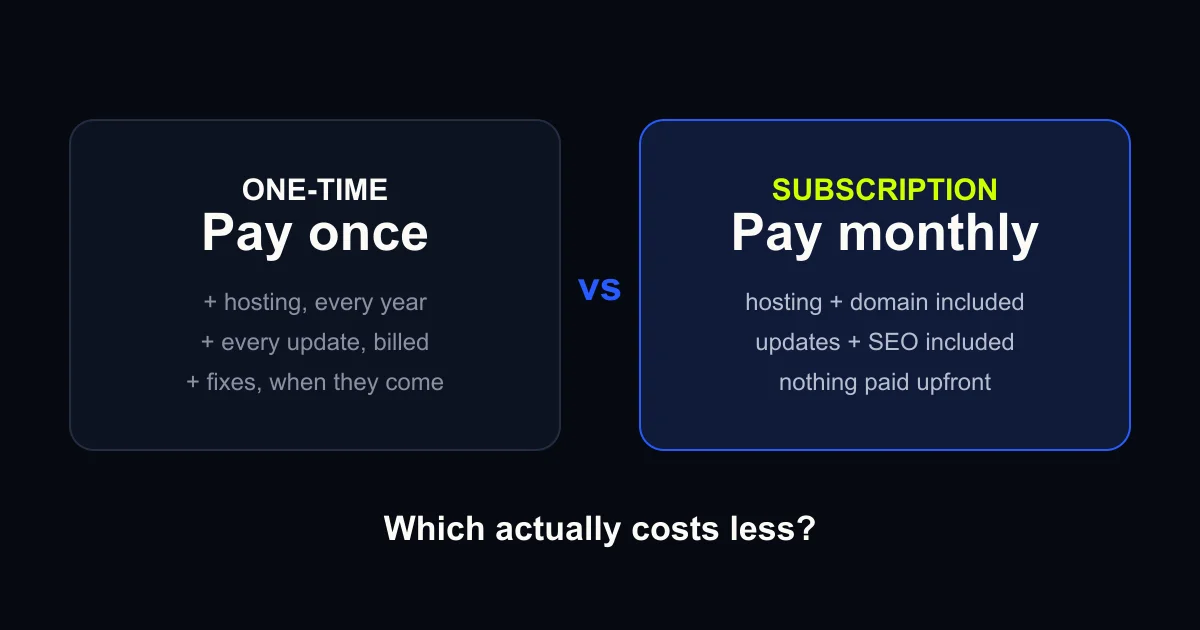
Quick answer: buying a website outright is cheaper only if nothing about it needs to change. Count hosting, updates, fixes and SEO after launch and the gap closes quickly — and a website subscription is the only option where those jobs belong to someone other than you.
| Buying outright | Website subscription | |
|---|---|---|
| Paid upfront | Most or all of the build | Nothing, on our plan |
| Hosting and domain | Billed to you yearly | Included |
| Updates and fixes | Your time, or hourly | Included |
| SEO after launch | Rarely included | Included |
| Who runs it in month six | You | Us |
Every small business shopping for a website hits the same fork: pay once and own it, or pay monthly and subscribe to it. The one-time quote looks like the obvious winner — a known figure, then done. But "done" is the part that isn't true, and the comparison only makes sense once you price what happens after launch.
The comparison people actually make — and what it misses
The instinctive comparison is the one-time fee against twelve months of subscription. On that maths, a cheap web designer charging a flat fee often looks better by the end of year one.
What that leaves out is everything a website consumes after it goes live:
- Hosting and the domain — billed every year, forever, whoever built it.
- Updates — new prices, new staff, new photos. Either someone does them, or the site quietly goes stale.
- Fixes — broken forms, expired certificates, plugins that stop working. These arrive uninvited.
- SEO — rankings are earned by a site that keeps changing, and lost by one that doesn't.
A one-time payment website hands all four back to you the day it launches. A subscription keeps them inside the monthly price. That is the real difference — not how much you pay, but what stops being your problem.
When buying a website outright genuinely wins
Honesty first: over a long enough run, a one-off build can cost less in pure money — if nothing needs doing to it. If your services, prices, team and photos will genuinely not change, and you're comfortable managing hosting renewals and the occasional breakage yourself, buying outright is defensible. Some brochure sites live like that for years.
The catch is that very few working businesses actually stand still. The quote that looked final grows a hosting invoice, then a "small change" invoice, then a rescue invoice when something breaks in year two. Our UK website cost breakdown and Canadian website cost guide walk through what those follow-on costs typically look like, and cheap web designer vs website subscription prices the low-quote version of the same choice.
When a website subscription wins
A subscription wins whenever the site is supposed to do something ongoing: rank in local search, take bookings, reflect this month's prices, look like the same business as your social media. All of that is maintenance work on a schedule — the exact work most owners stop doing within a couple of months of launch, not from laziness but because it competes with running the business.
There's also the start. A one-time build is paid — at least in part — before you've seen anything. A subscription built the way we run it inverts that: the site is built first and shown live, and nothing is paid until you've seen it. No deposit is the part of the model a one-time quote structurally cannot offer, because the one-time agency's entire payday depends on being paid before the site has proven anything.
The question that decides it
Skip the spreadsheet and ask one thing: who is responsible for this website in month six?
If the honest answer is "me, in my spare time" — and you'll actually do it — buy it outright and keep the schedule. If the honest answer is "nobody, unless it's someone's job", the subscription isn't the expensive option. It's the only version where the website still works a year later.
Our pricing shows exactly what the monthly figure covers — hosting, domain, SEO, updates and support in one price, with nothing billed separately and nothing paid before the site exists.